Permanent OBD2 Code After Repair: Compare the Evidence
A permanent diagnostic trouble code (PDTC) that remains after a repair is not a timer and does not by itself prove that the repair failed. The vehicle’s own OBD system retains a permanent code until the related monitor runs and no longer detects the condition. Your next useful step is to compare the saved DTC history, the current confirmed/pending/permanent categories and monitor readiness. If there is no pre-repair scan, record that evidence gap instead of reconstructing a baseline.
OBD CAN team · Updated
What a permanent code tells you
Confirmed, pending and permanent codes are separate categories. A permanent code is kept by the vehicle’s OBD system and ordinarily cannot be erased by a scan-tool clear command or battery disconnection. After the related monitor completes and no longer detects the condition, the vehicle can remove the permanent code under its own rules. How soon the monitor runs depends on the specific vehicle and operating conditions; there is no universal mileage, number of starts or number of days.
That is why the word “permanent” does not mean the fault is permanent or the part must be replaced. It also does not prove that an earlier repair fixed the issue. A current confirmed or pending code, a returning MIL or symptoms that return are different evidence from a PDTC that has not yet cleared. Record each observation rather than collapsing them into a pass/fail verdict.
Compare reports field by field
In OBD CAN, open the saved DTC report when available, then run a new standard OBD2 DTC read while parked with a compatible BLE adapter. The app requests Mode 03 confirmed, Mode 07 pending and Mode 0A permanent codes. Compare the exact code within each category and note the report date. A history record and a new reading are separate reports; OBD CAN does not automatically certify a repair or present an automatic before/after diagnosis.
| Evidence to compare | If you have a pre-repair report | If no baseline was saved |
|---|---|---|
| Confirmed codes | Check whether the same code is still present or appeared again. | Record the current category. You cannot infer its earlier state from this scan. |
| Pending codes | Check whether the same code has returned under the vehicle’s criteria. | Save the current result and ask for prior scan data if available. |
| Permanent codes | Note that the code remains or has cleared from the latest report; keep the monitor state with it. | A present PDTC is current evidence, not proof of when it first set or what work was done. |
| Readiness | Compare the same supported monitor and reporting period. | Record current support/readiness and whether the ECU reports a recent clear. |
If you have the invoice or work order, keep it as a separate source for what was repaired and when. The scan report does not contain or verify the shop’s finding. A not-ready monitor means its check has not completed for that period. A ready monitor means the onboard test completed, not that every part passed a physical inspection.
Open a real report and use its built-in questions
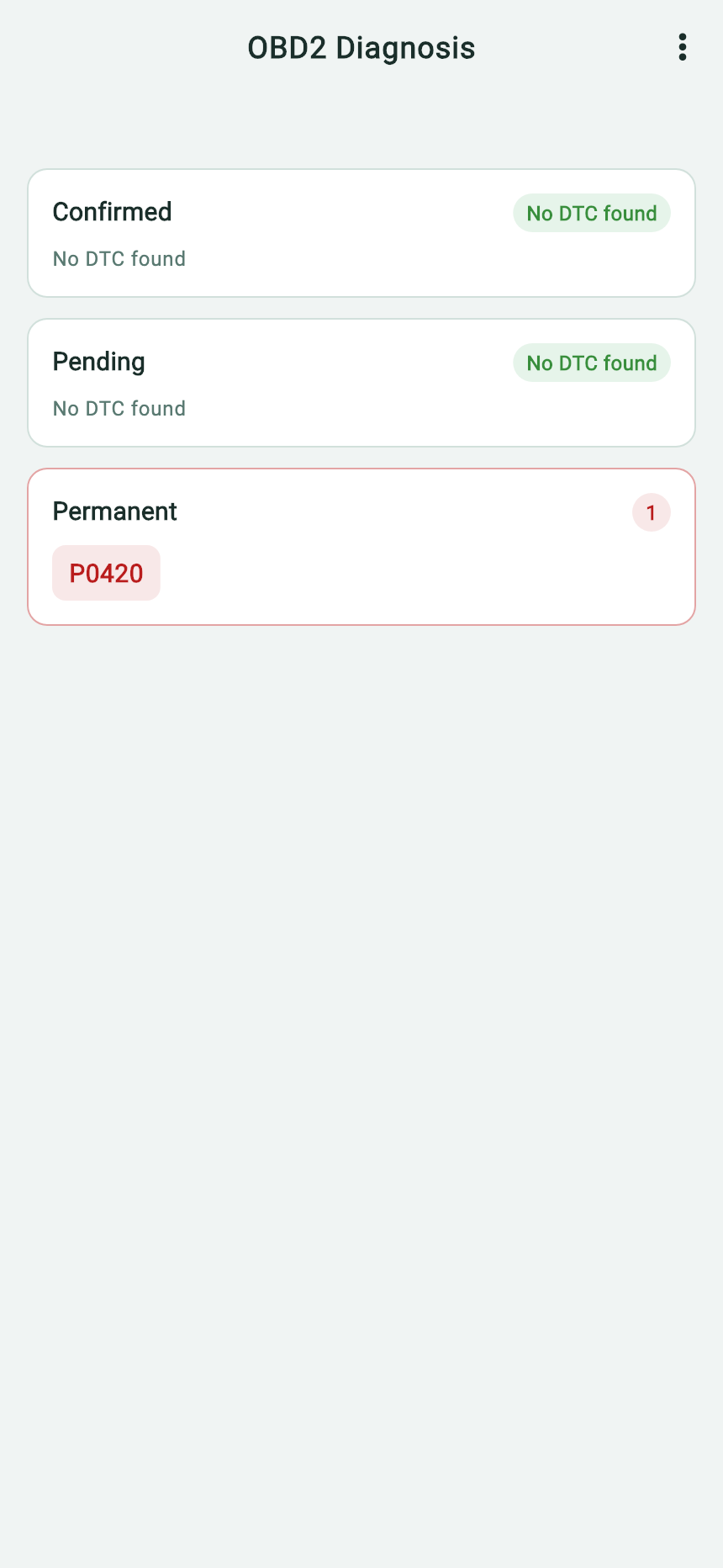
- Confirmed and pending categories are displayed separately from permanent.
- The single P0420 entry is labelled Permanent in this demonstration.
- The report and app questions can be copied from an eligible code result or historical view.
From an eligible saved report, tap ⋮ More Options, then select Copy AI Prompt Template. The copied text contains all three categories plus five fixed questions for general DTC analysis. They are not permanent-code-specific questions and do not decide whether a repair succeeded. The text below is the actual English clipboard output for this example report.
# 🚗 OBD2 Vehicle Diagnostic Report

## Confirmed DTCs — 0
None

## Pending DTCs — 0
None

## Permanent DTCs — 1
P0420

---

Based on the above OBD2 diagnostic report, please help me analyze:
1. What does each fault code mean and what are the possible causes?
2. Which faults are the most urgent and need immediate attention?
3. Are there any relationships or correlations between these fault codes?
4. What are the recommended repair solutions and estimated costs?
5. Do these faults affect driving safety? Can I continue driving?
Download the exact English App report and built-in questions. A new live DTC result with at least one code also offers this copy action; a new live result with all three categories empty does not. Paste the copied text into your usual AI, add the vehicle and work-order details you choose to share, and ask it to distinguish reported evidence from missing records. Review identifying details before using an external service. See the report-to-AI walkthrough.
Decide whether the next step is to wait, recheck or diagnose
- Only the PDTC remains and its related monitor is not ready: save both reports, confirm whether codes were cleared or the battery disconnected, then consult the maker’s monitor conditions. Do not rely on a generic drive cycle or promise a clearance date.
- The related monitor completes and the PDTC clears: this shows the vehicle no longer reports that permanent code in the current report. Compare other categories, readiness and symptoms before treating the matter as resolved.
- A confirmed or pending code returns, the MIL returns, or the same symptom persists: preserve the latest report and any freeze-frame data the tool supplies, then use the maker’s procedure or return to a qualified repairer with the actual work record.
- No earlier report exists: ask the repairer for the earlier scan and work order if needed. One current report cannot reconstruct a missing baseline.
Do not repeatedly issue a clear command. It does not repair the underlying condition and it can reset readiness information used to show whether monitors have run. Inspection rules depend on the jurisdiction. California’s Bureau of Automotive Repair describes PDTC inspection criteria for its Smog Check program; those criteria should not be applied as a nationwide pass/fail rule.
Primary references and scope
- California Bureau of Automotive Repair, Permanent Diagnostic Trouble Codes: describes that a scan tool or battery disconnect cannot erase a PDTC and the related monitor must complete without detecting the condition. Its inspection rules apply to California’s program.
- California Bureau of Automotive Repair, OBD Test Reference: California Smog Check procedures and vehicle-specific exceptions.
- U.S. EPA, Performing Onboard Diagnostic System Checks as Part of a Vehicle Inspection and Maintenance Program: general readiness and monitor-completion context.
For the three code categories, see OBD2 trouble-code diagnosis; for the related self-test, see Monitor Status.